
EB-2 vs EB-3 Visa: Which One Is Better for You?
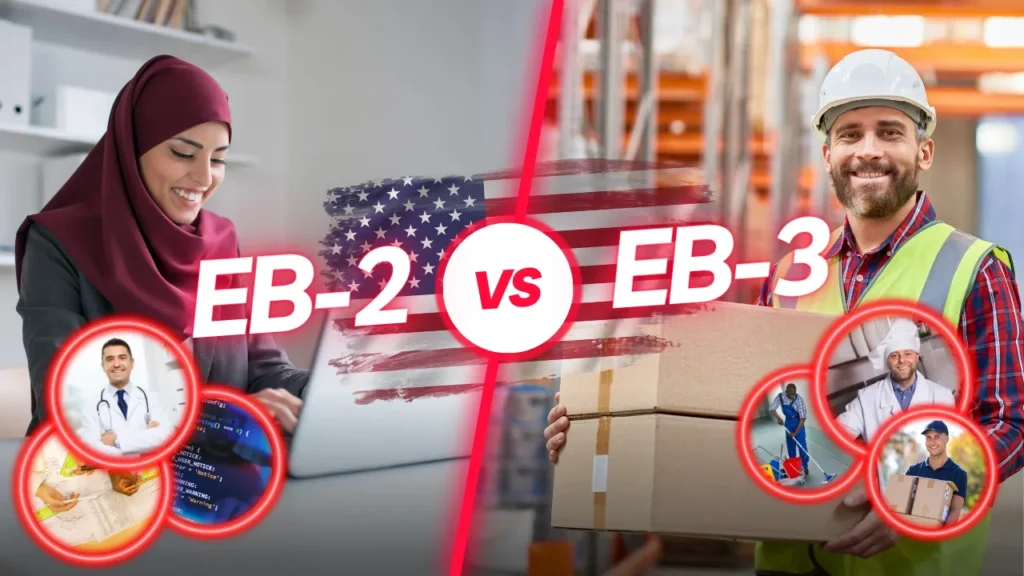
If you’re planning to move to the U.S. through employment, chances are you’ve heard of EB-2 and EB-3 visas. But how do you decide which one is the better fit? It’s not just about qualifications—timelines, green card backlogs, job requirements, and even your country of birth all play a part.
This comprehensive guide breaks down everything you need to know about the EB-2 and EB-3 visa categories—from eligibility criteria to processing time and strategic tips to make the right decision for your immigration goals.
Understanding the EB Visa Categories
What is an Employment-Based (EB) Visa?
Employment-Based (EB) visas are U.S. green cards granted based on professional skills or employment offers. They are divided into five preference categories (EB-1 to EB-5), with EB-2 and EB-3 being the most commonly used for professionals and skilled workers.
Each category has different requirements and benefits—and most importantly, different waiting times. This is why understanding the distinction is crucial before you apply.
Why Choosing the Right Category Matters
Picking the wrong category can delay your green card for years. Some applicants are eligible for both EB-2 and EB-3, but one may offer faster processing or better chances of approval depending on your background and the visa bulletin timeline for your country.
What is the EB-2 Visa?
The EB-2 visa is designed for professionals who hold advanced degrees or possess exceptional ability in their field. It’s a second-preference green card and often provides quicker access to permanent residency—if you qualify.
Who Qualifies for EB-2?
To apply under EB-2, you must meet one of the following:
- Have an advanced degree (master’s or higher), or a bachelor’s plus five years of progressive experience in your field.
- Show exceptional ability in sciences, arts, or business—meaning a degree of expertise significantly above the norm.
Subcategories Within EB-2
There are two major subcategories:
- EB-2A (Advanced Degree Professionals)
- EB-2B (Exceptional Ability)
The National Interest Waiver (NIW)
A unique feature of EB-2 is the National Interest Waiver. It lets you skip the job offer and labor certification requirement if you can prove that your work benefits the U.S. national interest
Benefits of NIW:
- Self-petition (no employer needed)
- Faster process for qualified individuals
- Ideal for researchers, doctors, engineers, and academics
What is the EB-3 Visa?
The EB-3 visa is the third-preference category and applies to a broader range of workers, including professionals, skilled workers, and unskilled labor.
Who Qualifies for EB-3?
EB-3 is divided into three subgroups:
- Professionals – Bachelor’s degree holders
- Skilled Workers – Minimum 2 years of experience or training
- Other Workers – Unskilled labor requiring less than 2 years of experience
Unlike EB-2, there’s no need to show exceptional ability or advanced education, which makes EB-3 more accessible—but it also comes with longer wait times in many cases.
EB-2 vs EB-3: Side-by-Side Comparison
| Feature | EB-2 | EB-3 |
|---|---|---|
| Education | Master’s or Higher, or Bachelor’s + 5 years | Bachelor’s, or 2+ years of experience, or less |
| Experience | Required (for Bachelor’s holders) | Varies by subcategory |
| National Interest Waiver | Available | Not available |
| Labor Certification (PERM) | Required (unless NIW) | Required |
| Priority Date Movement | Faster (usually) | Slower |
| Country-specific Backlogs | Less severe (for some) | More severe (esp. India, China) |
Educational and Experience Requirements: EB-2 vs EB-3
EB-2 Requirements in Detail
To apply under EB-2, education and experience are key:
- If you have a U.S. master’s degree or foreign equivalent, you're good to go.
- If only a bachelor’s degree, you must show 5+ years of progressive work experience
“Progressive” means your responsibilities have increased over time—basic work won’t cut it.
EB-3 Requirements in Detail
For EB-3, the bar is lower:
- Bachelor’s degree is enough for “professionals”
- Just 2 years of experience or training works for “skilled workers”
- No formal education or training is required for “other workers”
This makes EB-3 more accessible but also far more competitive.
PERM Labor Certification Process
Both EB-2 and EB-3 (except for NIW) require a PERM Labor Certification.
What is PERM?
Can You Convert a Temporary Work Visa into a Green Card?
Both EB-2 and EB-3 (except for NIW) require a PERM Labor Certification.
- Advertise the job
- Interview candidates
- Show that hiring a foreign worker won’t hurt U.S. wages or working conditions
How EB-2 and EB-3 Differ in PERM
EB-2 jobs often require higher education, which makes it easier to prove that qualified U.S. workers are not available. In contrast, EB-3 jobs may attract more local candidates, increasing scrutiny.
Backlogs and Country of Origin: The Game-Changer
Your country of chargeability (usually your country of birth) can greatly influence your wait time.
Why It Matters
Applicants from countries with high demand—like India and China—face long waits in both EB-2 and EB-3. But often, EB-2 moves faster than EB-3.
For example:
- An Indian applicant might wait 10+ years in EB-3 but slightly less in EB-2.
- A European or South American applicant might get through either category in 1–3 years
Check the monthly Visa Bulletin from the Department of State to stay updated.
EB-2 National Interest Waiver: A Shortcut for the Qualified
How It Works
You must prove:
- Your work has substantial merit and national importance.
- You are well-positioned to advance your field.
- It’s in the U.S. national interest to waive the job offer and PERM requirements.
Common NIW Professions:
- Scientists
- Engineers
- Healthcare professionals
- Entrepreneurs
- Environmental specialists
Employer Sponsorship Explained
Except for NIW, you’ll need a U.S. employer to sponsor you.
What Employers Must Do
- File the PERM application
- Pay associated costs (can’t pass them on to the employee)
- Submit Form I-140
Not every company is willing to go through this lengthy and costly process, so employer support is critical.
Switching Between EB-2 and EB-3
Yes, it’s possible.
- Your employer can refile the I-140 under a different category.
- You can use the same PERM (if valid for both).
- You keep your original priority date—which is crucial.
Pro tip: Don’t attempt this without expert legal guidance.
Tips for Choosing the Right Category
- Assess your qualifications honestly—don’t overshoot or undersell.
- Consult with an immigration attorney to evaluate strategy.
- Watch the Visa Bulletin regularly.
- Consider NIW if you work in a high-demand or strategic field.
- Think long-term —where do you want to be in 3–5 years?
Conclusion: So, EB-2 or EB-3—Which One’s for You?
There’s no one-size-fits-all answer. EB-2 is perfect if you have an advanced degree, exceptional ability, or qualify for the National Interest Waiver. EB-3 is more accessible and suits those with fewer qualifications or entry-level experience.
Here’s the bottom line:
- If you qualify for EB-2, go for it—especially with NIW.
- If you're early in your career, EB-3 can still get you to the U.S., just with longer waits.
- And if the Visa Bulletin shifts, be ready to adapt and downgrade or upgrade.
Whichever path you take, make it an informed one.
Disclaimer:
Some content on this website may be created or assisted using AI technology and is provided for general informational purposes only. It does not constitute legal, tax, accounting, financial, or immigration advice. Please consult a qualified professional for advice specific to your situation.
How to apply EB3 visa from Pakistan, How to apply for an EB3 Visa from the UAE, How to apply for an EB3 Visa from Bangladesh, EB3 visa jobs, EB3 visa consultants Pakistan Eb3 visa consultants Dubai, Eb3 visa consultants UAE, Eb3 visa consultants Bangladesh, EB3 visa timeline Pakistan,


 Total views : 543269